

Risk Management · 2025
In this section3 topics
Risk Management Policy & Plan
Sub Introduction
Currently, the Company has a comprehensive risk management plan that aligns with Enterprise Risk Management (ERM) guidelines. This plan aims to foster widespread and consistent accountability throughout the organization, effectively promoting sustainable competitiveness amidst rapidly changing environmental factors.
Instilling this as a culture through internal communication or various meetings not only raises awareness among executives, employees, and stakeholders but also encourages everyone in the organization to participate in analyzing, assessing potential risks and impacts, as well as continuously monitoring, reviewing operations, and ensuring systematic, consistent management with a unified standard.
Policy & Plan Description
Operational Framework
Prepare risk reports that align with comprehensive management processes.
Organize workshops for everyone to participate, establish appropriate working groups.
Manage risks through realistic simulations at appropriate frequencies.
Review risk management to ensure alignment with the organization's vision and goals.
Monitor and evaluate operational results to ensure they align with the plan.
Report operational results at all levels at least twice a year.
Integrate risk criteria into product and service development and improvement.
Conduct reviews of risk manuals and policies at least once a year.
Risk Management Structure
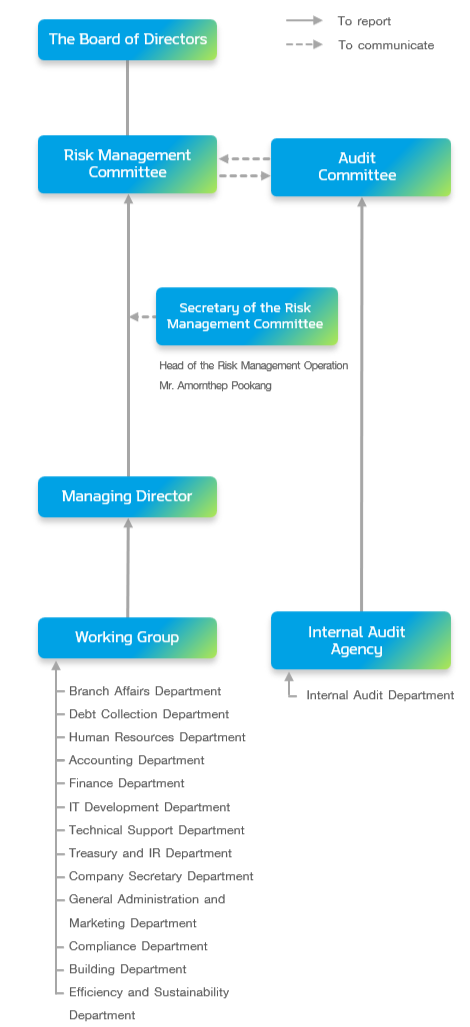
Company's Board of Directors
Approve policies and acceptable scope.
Supervise and monitor risk management to ensure effective and continuous implementation.
Risk Management Committee
Review risk management reports to ensure they are at an acceptable level.
Audit Committee
Conduct independent reviews to ensure that risk management operations are effective.
Secretary of the Risk Management Committee
Present policies, strategic plans, and identify significant risks.
Coordinate with the board or relevant parties.
Report risk management to the Risk Management Committee at least twice a year.
Executives and Employees
Manage and report risks to supervisors in daily operations.
Working Group
Present policies and strategic plans to the Managing Director.
Implement approved risk management policies and guidelines in responsible departments.
Support the development of an appropriate risk management and internal control culture in responsible departments.
Internal Audit Department
Proceeds a review to ensure that the internal control is conducted appropriately at least once a year.
Plan audits based on risks.
Coordinate with working groups to exchange information on risks that may affect the company.
Risk Management Culture
Executives and employees must implement risk management in operations, decision-making, and daily tasks.
Executives and employees must manage risks that affect the achievement of the company's objectives.
Executives and employees must monitor and evaluate risk management results, as well as review and participate in improving the risk management system for efficiency.
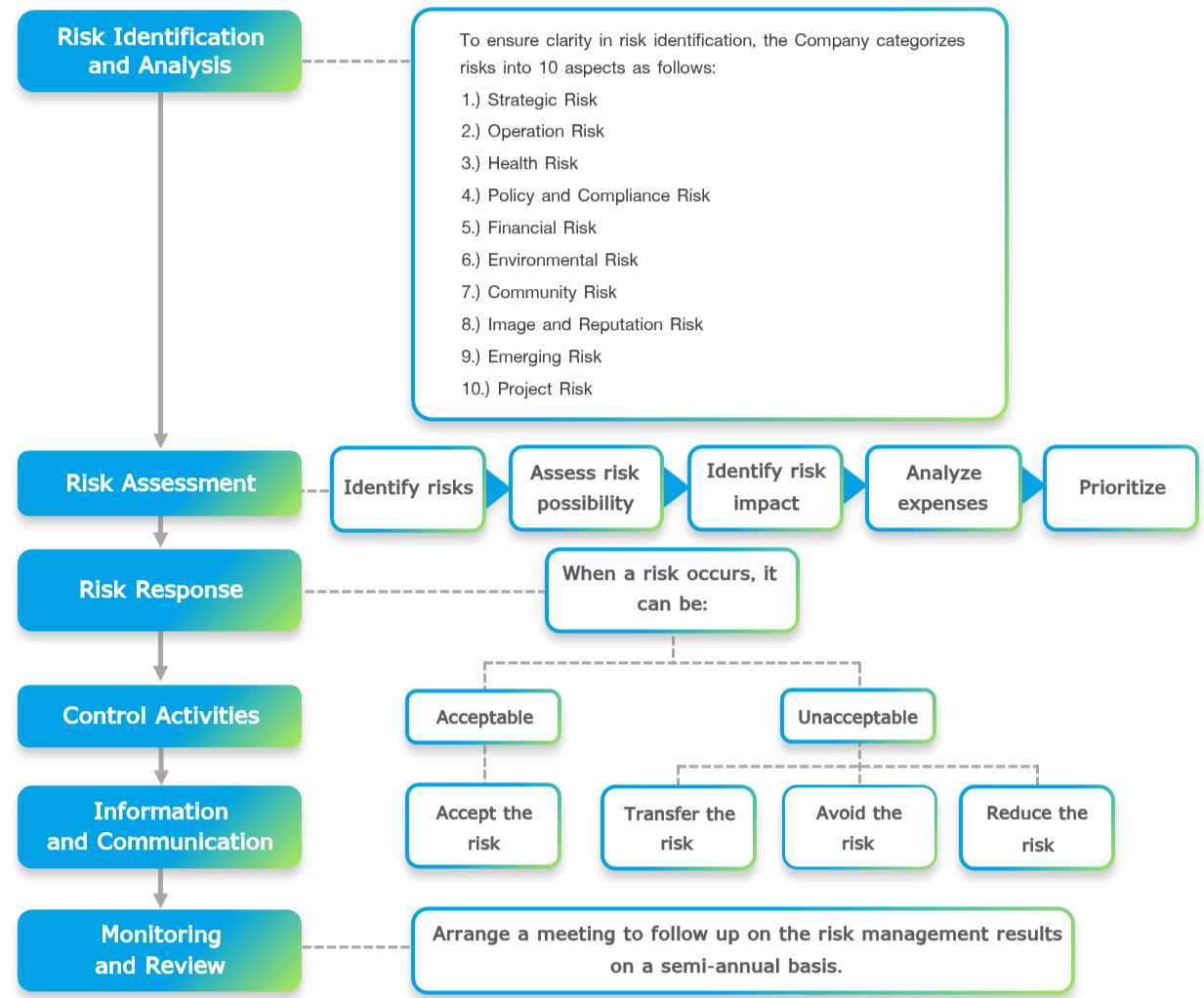
Risk Management Process
The risk management process begins with identifying potential risk issues, followed by risk assessment based on the level of impact and frequency. Next is risk response, with four options: accept, transfer, reduce, and avoid. This is followed by defining control activities to reduce risks to an acceptable level, communicating them to internal personnel for understanding and application in operational processes, and finally, monitoring and evaluating to ensure effective risk management and to develop and improve risk management plans to be more appropriate and efficient.
Policy Document Link
https://sustainability.muangthaicap.com/en/risk.html
Risks to the Company's Business Operations
Introduction
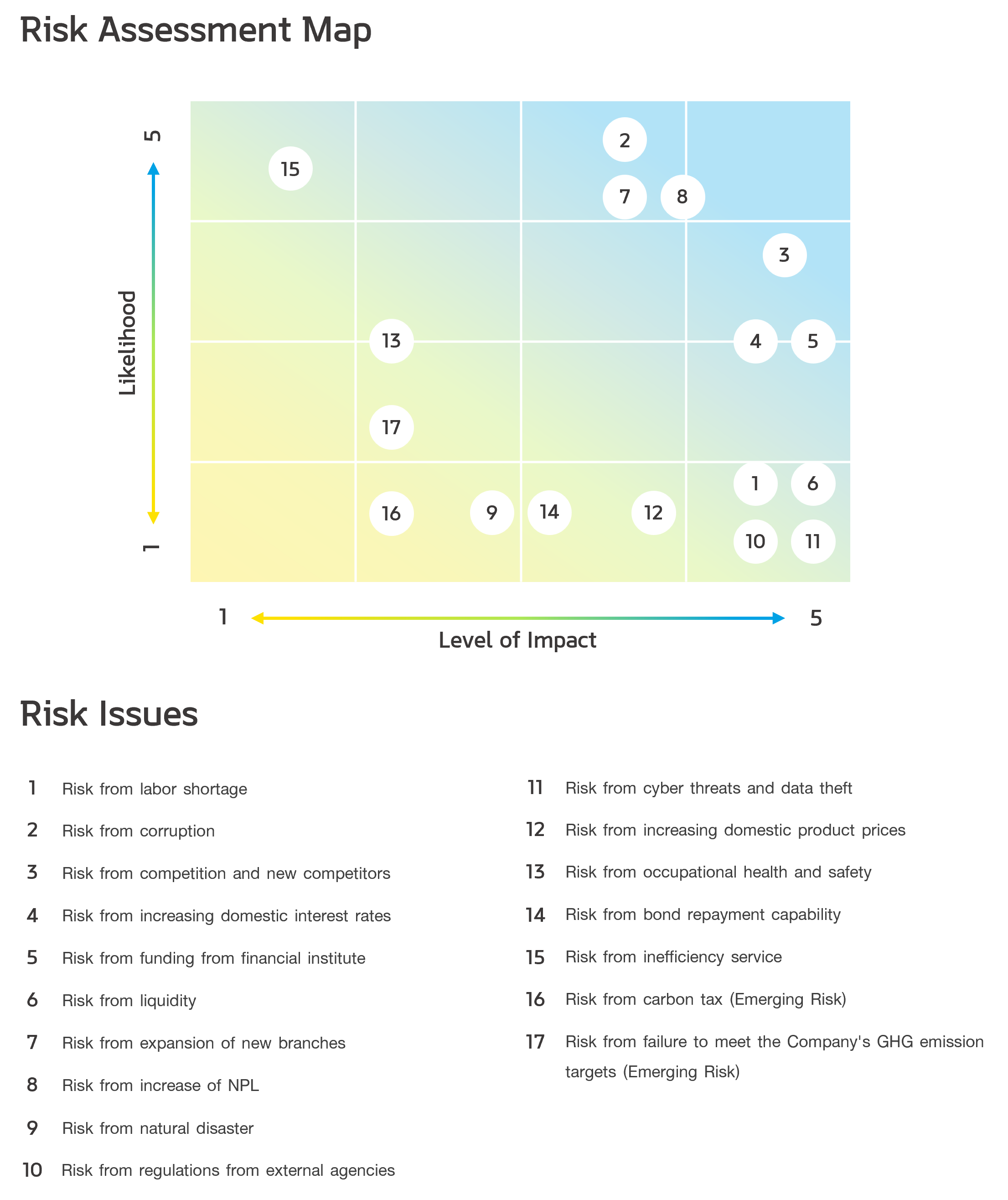
Risk Register
| Risk Name | Risk Characteristics | Consequences | Management Measures | Related Risk Factors |
|---|---|---|---|---|
| Personnel Shortage | With the goal of expanding branches nationwide, it is necessary to recruit sufficient personnel in the branches to support business growth. Furthermore, the microfinance business group faces increasing competition, making employee recruitment more challenging. The Company also faces the challenge of retaining and motivating experienced and skilled employees to remain with the organization. | Lack of adequate personnel for the company's growth | Motivate and foster a positive working environment for employees. | 738 · Description: Reliance on employees in key positions · Info category: OPERATIONAL_RISK · 739 · Description: Shortage or reliance on skilled workers · Info category: OPERATIONAL_RISK |
| Corruption | Good corporate governance is a system that demonstrates effective management capability. Without transparent management, it inevitably impacts the trust of all stakeholders. Therefore, the Company adheres to ethics and transparency as core principles in its business operations, while recognizing potential corruption issues and being committed to absolutely preventing such incidents within the organization. Measures have been put in place to prevent corruption to reduce potential risks by establishing an anti-corruption policy. ruption tion, the No Gift Policy, and the Complaint Handling Policy are disclosed to all stakeholder groups of the Company. The Company provides channels for whistleblowing or reporting ethical and legal misconduct via the Company's website, email whistleblower@muangthaicap.com and mail. Furthermore, the causes are reviewed, and preventive measures against corrup ruption consistently, through effective internal control and inspection, with risk assessment at every stage of operations. Should an employee be found to have committed corruption, the Company has a policy to impose the most severe disciplinary action. All employees receive training to foster a culture focused on integrity and honesty, which is considered a crucial foundation for building trust with all customers and stakeholders, including increasing channels for reporting corruption ( Whistleblowing) to facilitate incident reporting, as well as joining the Private Sector Collective Action Coalition Against Corrup corruption of the private sector ( CAC) and encouraging partners to join in combating corrup ruption tion through supporting participation in the network CAC to continuously foster transparency and shared responsibility across all sectors. In 2025, the Company detected a total of 0 cases of corruption. | Investor perception and confidence in the Company | Moral development training and ethics for employees | 736 · Description: Damage to company image and reputation · Info category: STRATEGIC_RISK · 754 · Description: Corruption · Info category: OPERATIONAL_RISK |
| Competition and New Competitors | Currently, numerous new micro-lending service providers have emerged, leading to intensified competition within the industry. This includes aspects such as developing products that best meet customer needs, offering easily accessible interest rates, and providing excellent service quality, which impacts customer satisfaction and loyalty. These factors help retain existing customers and attract new ones. Therefore, the Company must adapt to the competition and regularly review its strategies and operational plans to cope with changes and challenges in the highly competitive lending industry. Additionally, the Company focuses on growth by increasing the new customer base through expanding branches to cover all areas with the goal of increasing financial access opportunities ( Financial Inclusion) along with retaining the existing customer base arranges for monitoring of satisfaction to meet the evolving needs of customers at all times In the year 2025 Previously, the Company remains the number one leader in the microfinance business ce In this regard, the Company will not cease development and aims to become a microfinance business ce global | Operating results did not meet the target | Formulate a strategic plan to maintain Business Leadership | 729 · Description: Behavior or needs of customers / consumers · Info category: STRATEGIC_RISK · 1725 · Description: Income volatility · Info category: FINANCIAL_RISK · 1714 · Description: Competition risk · Info category: STRATEGIC_RISK |
| Domestic interest rate hike | The increase in domestic interest rates impacts operational costs, as market fluctuations could lead to higher borrowing costs for the Company. Currently, the Company is offering loans at interest rates below the legal limit set by the Bank of Thailand. However, if financial costs or other liabilities rise in the future, the Company will consider adjusting its interest rate ceiling accordingly. Additionally, the Company has diversified its funding sources by issuing bonds, obtaining financing from both domestic and international sectors, thereby reducing the risk from domestic interest rate hikes. In 2025, the Company entered into a funding agreement with a credit line exceeding 270 million USD in collaboration with two global financial institutions: the Bank of China (BOC), Asian Development Bank (ADB) and Sumitomo Mitsui Banking Corporation (SMBC). | Financial costs increased | Secure other reserve funding sources and increase interest rates received | 764 · Description: Fluctuation in exchange rates, interest rates, or the inflation rate · Info category: FINANCIAL_RISK |
| Obtaining funding from financial institutions | Funding is therefore a crucial factor in the expansion of the credit service business. Over-reliance on funding sources, particularly commercial banks, may lead to risks associated with excessive dependence on a single financial institution. Furthermore, the overall industry landscape can influence changes in lending policies for small financial institutions, which, in turn, becomes a limitation in the consideration of credit provision to the Company. To diversify risk, the Company has developed a funding plan from both domestic and international financial institutions to reduce financial costs and maintain the Company's liquidity. This is achieved by utilizing diverse funding sources, such as issuing debentures and borrowing from domestic and international banks, to ensure that the Company has an appropriate financial structure and can stably support its business operations, while continuously improving and developing its funding plan. | Suspension of credit line usage and non-approval of new credit line | evaluate and monitor financial ratios consistently | 761 · Description: Insufficient sources of funding · Info category: FINANCIAL_RISK · 762 · Description: Change in financial and investment policies of financial institutions that affect business operations · Info category: FINANCIAL_RISK · 1724 · Description: Liquidity risk · Info category: FINANCIAL_RISK |
| Cost-effectiveness of branch expansion | To expand opportunities for access to financial services, expanding branches to cover nationwide areas is one of the key factors that will help the company grow according to its set goals. However, opening new branches entails risks regarding the cost-effectiveness of branch expansion. Without proper management, this could affect the business's operational performance and investor confidence. The Company therefore strictly analyzes and plans branch openings by surveying areas, population density, target customer groups, performance of nearby branches, and analyzing important financial data such as payback period (Payback Period) Return on Investment ( Return on Investment) must not be lower than the specified criteria, including adjusting strategies for acquiring new customers to further enhance the operational efficiency of the branches. The target for accounts receivable per branch is set at no less than 19 million baht. In 2025, it was found that the accounts receivable per branch amounted to 21.13 million baht per branch and continues to show an upward trend every year. | Unprofitability in opening branches affects operational performance. | Review and adjust business plans to suit each area. | 728 · Description: Volatility in the industry in which the company operates · Info category: STRATEGIC_RISK · 729 · Description: Behavior or needs of customers / consumers · Info category: STRATEGIC_RISK · 1725 · Description: Income volatility · Info category: FINANCIAL_RISK · 748 · Description: Property lease agreement execution · Info category: OPERATIONAL_RISK |
| Increase in non-performing loans (NPL) | If debtors are unable to repay their debts as scheduled, the company will lose its primary interest income and may lose part or all of the principal, affecting its ability to do generate profit and business growth. To reduce the chance of non-performing loans, the company regularly monitors debt collection and applies standards MTC Model which is an important tool that helps increase efficiency in systematic debt management, including the sale of such debts to distressed asset management companies to transfer the risk of managing uncollectible debts. As a result, in 2025, the non-performing loan ratio of 2.53% which is lower than the set target of 2.8%. | Net profit decreased | Delay loan disbursement to high-risk customer groups and sell non-performing loans to other companies. | 765 · Description: Fluctuation in return on assets or investment · Info category: FINANCIAL_RISK · 1725 · Description: Income volatility · Info category: FINANCIAL_RISK |
| Natural disasters | The increasing trend of disasters from current windstorms and floods may result in damage to the Company's assets, particularly branch signs and promotional signs, leading to repair or replacement costs. This could also potentially affect the Company's image and the operational continuity of its branches. In 2025, the Company has communicated to its branches to regularly monitor and inspect the structural integrity of signs, especially during the rainy and storm seasons, and to review risk management guidelines. | Operations suspended | Allocate a budget to address impacts | 750 · Description: Climate change and disasters · Info category: OPERATIONAL_RISK |
| Regulations from external agencies | As a credit service provider under regulatory oversight, the Company must comply with the rules and regulations of various agencies. Should the organization fail to comply or comply incompletely, it could affect its reputation and credibility, including fines, potentially leading to the revocation of its license, which would severely impact future operations. In addition, there must be continuous review and monitoring of legal provisions from external agencies to adapt business operations to comply with regulations. This includes organizing training and testing on regulations and rules from regulatory bodies for all employees at least once a year. Furthermore, a legal compliance unit must be established, responsible for reporting operational results to the Board of Directors and management at least twice a year. As of 2025, the Company has no legal disputes whatsoever. | illegal and a lack of confidence among investors | Continuously monitor and review the rules and regulations of the company's regulatory authorities. | 756 · Description: Change in laws and regulations · Info category: COMPLIANCE_RISK · 758 · Description: Violations of laws and regulations · Info category: COMPLIANCE_RISK |
| Cyber threats and data theft | Currently, technology is developing by leaps and bounds, leading to cyber threats that cause damage and impact all sectors, and may appear in novel and difficult-to-detect forms. Customer data storage systems and various management operations are in digital format. The Company therefore establishes secure and efficient network systems and infrastructure through strict information security policies and measures, including training personnel to develop capabilities to keep pace with technological changes, and arranging for external agencies to review the systems annually. In 2025, the Company did not find any information technology security incidents or personal data breaches, which is in line with the Company's set goals. | violates the Personal Data Protection Act and the company lacks credibility | Implement modern technology in the organization | 732 · Description: Changes in technologies · Info category: STRATEGIC_RISK · 744 · Description: Information security and cyber-attack · Info category: OPERATIONAL_RISK · 736 · Description: Damage to company image and reputation · Info category: STRATEGIC_RISK |
| Increase in domestic product prices | The increase in product prices affects operating expenses. Therefore, the company has managed risks to control business costs by preparing annual budgets, surveying product prices, and planning to address rising product prices by employing a high-volume purchasing strategy to maintain quality and keep expenses at an appropriate level. This also includes securing alternative suppliers in case of price increases. The average unit price, when compared to the acceptable base price, has not increased by more than 4%. In 2025, the company was able to control the average product price to decrease to 1.73%, which is below the set target, creating an advantage in the organization's operating costs. | The Company's operating costs increased. | Establish expenditure ceilings and secure alternative partners | 733 · Description: Business operations of partners in the supply chain · Info category: STRATEGIC_RISK · 735 · Description: Reliance on large partners / distributors or few partners / distributors · Info category: STRATEGIC_RISK |
| Occupational health and safety of employees | Accidents caused by unforeseen circumstances can result in harm to the safety of employees' lives and property, potentially disrupting operations and affecting business continuity. Therefore, the Company prioritizes the welfare of its employees by implementing policies related to occupational health, safety, and the work environment. The Company also promotes safety and occupational health through various channels within the organization to minimize workplace accidents. In 2025, there were 74 reported accidents. | Operations were disrupted due to employee strikes. | Promote safety activities and provide safety equipment, such as safety helmets. | 749 · Description: Safety, occupational health, and working environment · Info category: OPERATIONAL_RISK |
| Inefficient service | Customers are one of the key stakeholders of the Company. Providing inefficient services can negatively impact the business in various ways. Not only prevent us from retaining existing customers, but it also causes us to lose opportunities for expanding our customer base to new groups. The ability to satisfy customers is crucial for our progress and sustainable growth in a highly competitive market. The Company provides training to employees to enhance service quality based on the principle of "Intimate services like closed family members." Customer feedback and complaints are used to improve operations, with a target customer satisfaction of at least 80%. In 2025, the satisfaction rating reached 93.78%, surpassing the set target. The Company is committed to continuously improving service standards for maximum customer satisfaction. | Unable to retain the customer base | Training and consulting on correct customer service methods | 738 · Description: Reliance on employees in key positions · Info category: OPERATIONAL_RISK · 739 · Description: Shortage or reliance on skilled workers · Info category: OPERATIONAL_RISK · 742 · Description: Human error in business operations · Info category: OPERATIONAL_RISK |
| Carbon tax | Many countries have begun implementing carbon taxes, and Thailand is another country that cannot avoid this. The Excise Department is preparing to announce carbon tax measures. If enforced, this could lead to increased operating costs and expenses for the Company. The Company must therefore prepare a response plan by organizing public relations to raise awareness among employees at all levels regarding resource utilization through various channels. Furthermore, resource consumption data is collected monthly to monitor and analyze usage, in order to refine measures appropriately. The target is to limit the increase in carbon footprint to no more than 10% from the previous year, with a reduction in 2025 of 11 .07% | Operating costs have increased | Reduce greenhouse gas emissions from organizational operations | 756 · Description: Change in laws and regulations · Info category: COMPLIANCE_RISK · 765 · Description: Fluctuation in return on assets or investment · Info category: FINANCIAL_RISK |
| Failure to achieve organizational greenhouse gas emission targets | Greenhouse gas emission targets are a global agenda that all sectors, including investors, prioritize. Investors can choose to invest in businesses that are responsible and committed to addressing climate change. Organizations that fail to meet their established greenhouse gas emission targets may lose investor confidence. Therefore, it is crucial for companies to closely monitor their operations. In 2025, the Company is committed to reducing greenhouse gases by setting clear targets and a systematic action plan as follows:
| Loss of investor confidence and lack of credibility | Closely monitor the organization's performance and initiate projects related to greenhouse gas reduction. | 736 · Description: Damage to company image and reputation · Info category: STRATEGIC_RISK · 750 · Description: Climate change and disasters · Info category: OPERATIONAL_RISK |
Risks to Securities Holders' Investment
Risk Register
| Risk Name | Risk Characteristics | Consequences | Management Measures | Related Risk Factors |
|---|---|---|---|---|
| Shareholder Risk | Risk from reliance on the existing shareholder group and having a major shareholder holding more than 50% of the registered capital, as the Company's major shareholder is the Patcharachai family, which holds 1,435,038,600 shares or 67.691% of the Company's paid-up capital (as of 31 December 2025) | significantly impacts the consideration and resolution of important matters at the shareholders' meeting. | However, the Company has appointed 4 independent directors out of a total of 7 directors, where the Chairman of the Board and the entire Audit Committee are independent directors. This is to consider transactions that may give rise to conflicts of interest, in accordance with the laws and regulations of the Stock Exchange of Thailand and the Securities and Exchange Commission (SEC), to ensure that such transactions are reasonable and provide the utmost benefit to the Company. Furthermore, this promotes transparency and accountability in the Company's management, thereby building confidence among all stakeholders. | 2969 · Description: Risk of the company having a majority shareholder holding > 50% of shares · Info category: HOLDER_RISK |
| Credit Risk | Bondholders face the risk of not receiving interest or principal payments if the business performance or the bond issuer's performance does not meet expectations, or if the bond issuer's assets are insufficient to cover the debt. Therefore, prior to making an investment decision, investors should thoroughly review the details from the registration statement and the draft prospectus, as well as assess the financial position and debt repayment capability of the bond issuer, which is reflected in the credit rating provided by a credit rating agency. | Debenture holders face the risk of not receiving interest or principal payments. | Please note that the credit rating does not constitute a recommendation to buy, sell, or hold the offered debentures. Furthermore, the credit rating may be revoked or changed throughout the life of the debentures. Information can be tracked from the website of the SEC Office, credit rating agencies, or the Thai Bond Market Association. | 769 · Other name: Credit Risk · Description: Other · Info category: HOLDER_RISK |
| Ability to repay debentures | As the Company continuously raises funds through debenture issuance to serve as working capital for business operations, support expansion, and repay debentures or bills of exchange, the inability to repay debenture debt on time would damage the Company's image and investor confidence. The Company therefore mandates regular monitoring and evaluation of its debenture repayment capability, ensuring no default events occur, and considering appropriate interest rates for new debenture series. Over the past three years, the Company has had no history of debenture defaults, which has allowed it to maintain its long-term domestic credit rating at ‘ in 2025. A-( tha )’ with a stable credit rating outlook from Fitch Ratings | Investor confidence and the company's image | Regularly assess the company's ability to repay debentures. | 769 · Other name: Debenture Repayment Risk · Description: Other · Info category: HOLDER_RISK |
| Price Risk | Market price of the debentures may be subject to change depending on various factors, such as Level Rate Interest the money market, policies of the Bank of Thailand, overall economic conditions, inflation rate, the maturity of the debentures, or excess or deficit demand for the debentures. | Bondholders may be affected by the volatility of debenture prices in the event that the debt instruments are traded prior to their maturity. | Bonds with longer remaining maturities will be more affected by such fluctuations. | 769 · Other name: Price Risk · Description: Other · Info category: HOLDER_RISK |
| Financial Liquidity | Bondholders may not be able to sell the bonds before maturity at their desired price, as there may be limited secondary market trading of the bonds. The bond issuer will not be able to list the bonds for trading on the debt instrument market ( BEX) or any secondary market. However, bondholders may trade bonds at commercial banks, securities companies, or any other legal entity holding a license to trade debt instruments, if there is a buyer or seller offering to trade bonds through such licensed entity. above. Furthermore, shareholders will generally not be able to sell or transfer shares to any person, but will be restricted to selling or transferring bonds only within the group of institutional investors and high-net-worth investors. This is because the bond issuer has registered transfer restrictions with the SEC, in accordance with the definitions specified in the Notification of the Securities and Exchange Commission No. Kor Jor 5/2562 Re: Determination of Definitions in Notifications Concerning the Issuance and Offering of All Types of Debt Instruments, dated March 13, B.E. 2552 (as amended or superseded), and in accordance with the Notification of the Securities and Exchange Commission No. Kor Jor 4/2560 Re: Determination of Definitions of Institutional Investors, Ultra High-Net-Worth Investors, and High-Net-Worth Investors, dated February 8, B.E. 2560, except in the case of transfer by inheritance. | Slowing down loan disbursement and branch expansion | Formulate an appropriate financing plan | 769 · Other name: Liquidity Risk · Description: Other · Info category: HOLDER_RISK |